
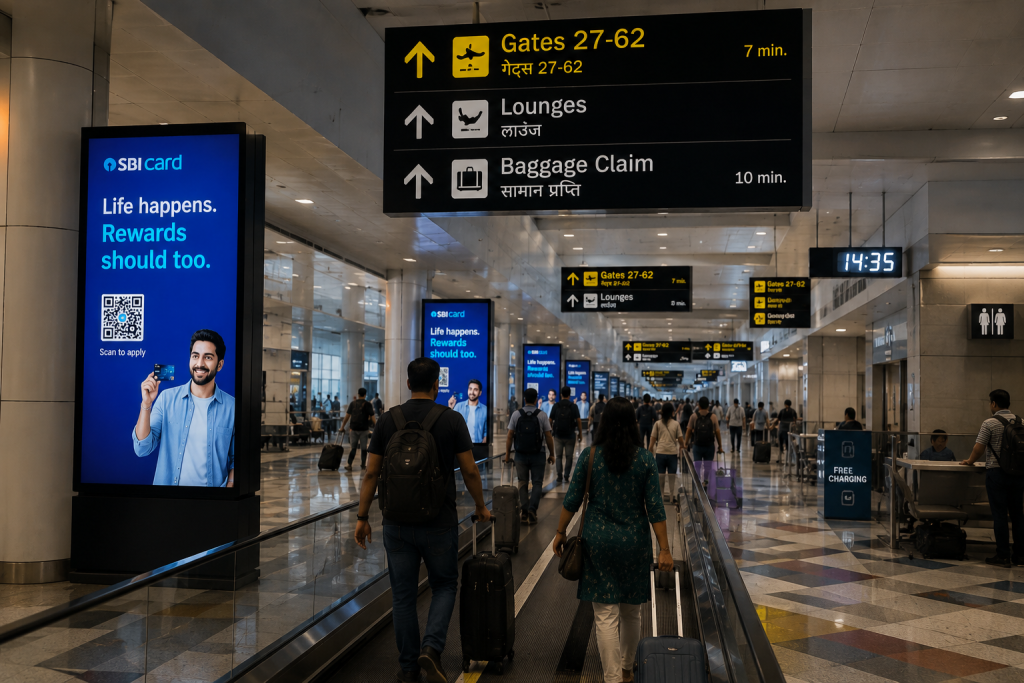

Airport advertising is often associated with premium audiences and long dwell times, but one of its most overlooked strengths is directional attention. Airports are environments where passengers actively search for information, and this creates a powerful advertising advantage that few other media environments can replicate.
Why passengers naturally look at airport signage
Every traveler depends on wayfinding systems to navigate the airport. Gate numbers, terminal directions, baggage claim signs, security routes, and boarding information become essential visual references throughout the journey.
Unlike many advertising environments where brands compete for attention, airport advertising can align with existing attention patterns. Passengers are already scanning their surroundings, making directional media locations exceptionally valuable.

The difference between interruption and alignment
Traditional advertising often interrupts what people are doing. Airport advertising can do something different: it aligns with passenger movement. A digital screen near a gate, a branded walkway, an escalator panel, or a directional corridor display is encountered during purposeful navigation.
Because the advertising appears within the flow of movement, it feels more integrated into the environment. This increases the likelihood that the message will be noticed and remembered.
Movement creates repeated exposure
Airport journeys involve multiple navigation decisions. Travelers move from entrance to check-in, security, retail areas, lounges, boarding gates, and arrival zones. Each transition creates another opportunity for directional advertising exposure.
This repeated interaction strengthens familiarity. A brand encountered across several navigation points becomes associated with the airport experience itself, reinforcing recognition through context and repetition.
Why directional attention matters for brands
The directional attention economy is particularly valuable for financial services, airlines, technology brands, automobiles, luxury products, travel platforms, and consumer brands seeking premium visibility. These campaigns benefit not only from audience quality but also from high-intent visual attention.
Advertising placed within navigation pathways captures moments when passengers are actively processing environmental information, making the exposure more meaningful than passive viewing.