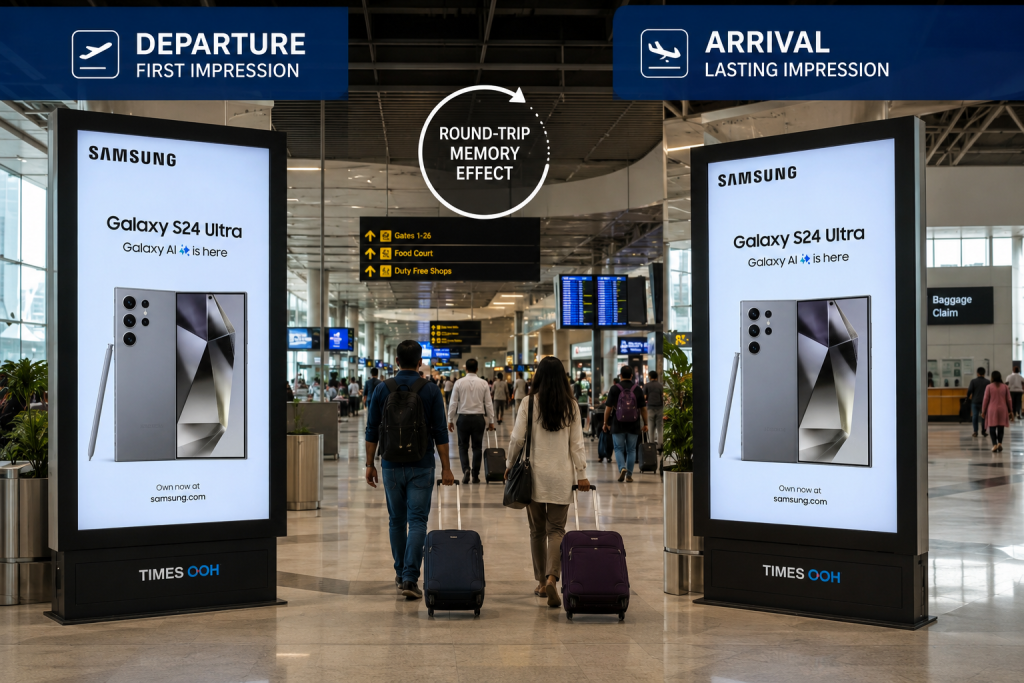

Airport advertising has a powerful advantage that many media channels cannot replicate: repeated exposure within a single travel cycle. A traveler often encounters the same brand during departure and again during arrival or the return journey. This creates what can be called the round-trip memory effect, where airport advertising influences consumers twice in the same journey and significantly strengthens brand recall.
Why repeated exposure matters
Marketing research has long shown that repetition improves memory. A single advertisement may create awareness, but repeated exposure reinforces recognition and familiarity. Airports naturally provide this opportunity because travelers move through similar environments during both departure and return.
A passenger may see a campaign at check-in, security, boarding gates, baggage claim, or airport exits on multiple occasions within the same trip. Each exposure strengthens the mental connection with the brand.
The psychology of the round-trip memory effect
The first exposure introduces the message. The second exposure confirms it.
When travelers encounter the same creative again, the brand feels more familiar and trustworthy. Familiarity reduces cognitive effort and increases the likelihood of future consideration. This is especially valuable for categories such as banking, insurance, automobiles, travel, technology, luxury products, and premium consumer brands.
The airport environment also enhances this effect because travelers are often alert, observant, and engaged with their surroundings.

Departure and arrival create different attention states
The round-trip memory effect works because departure and arrival are psychologically different moments.
During departure, travelers are planning, anticipating, and making decisions.
During arrival, they are reflecting, evaluating, and reconnecting with everyday life.
A brand that appears in both contexts benefits from two different emotional states, making the message more memorable than a single isolated impression.
Building long-term brand memory
Repeated airport exposure creates cumulative memory. A traveler who sees the same campaign across multiple trips develops stronger brand familiarity over time.
This produces several advantages:
- Higher brand recall
- Increased recognition
- Greater trust
- Stronger purchase consideration
- Improved campaign efficiency
Airport advertising is therefore not only a reach medium but also a memory-building medium.
Creative strategy for round-trip campaigns
Brands can maximize the round-trip memory effect by using consistent visual identity, recognizable colors, simple messaging, and strategic placement across departure and arrival zones.
Consistency is critical. The goal is not simply repetition but reinforcement.